TSIA2 prep your math department can actually act on
Most placement prep tells a campus how many students passed. UnpackMath tells your math team which specific misconceptions are costing them, by class and by student, while there is still a semester left to fix it.
Misconception
Student inverts rise over run when reading slope from a table.
From placement risk to a named misconception
Four steps, and the fourth one is the part that usually never happens.
Diagnose
A 20-question adaptive test mirroring the TSIA2 blueprint. No accounts, no setup, no cost to students.
Pinpoint
Every wrong answer maps to a named misconception, not just a strand score.
Teach
A full curriculum across 97 topics, assignable by teachers and sequenced with completion gates.
Report
Class, teacher, and campus-level views of where student thinking is breaking down.
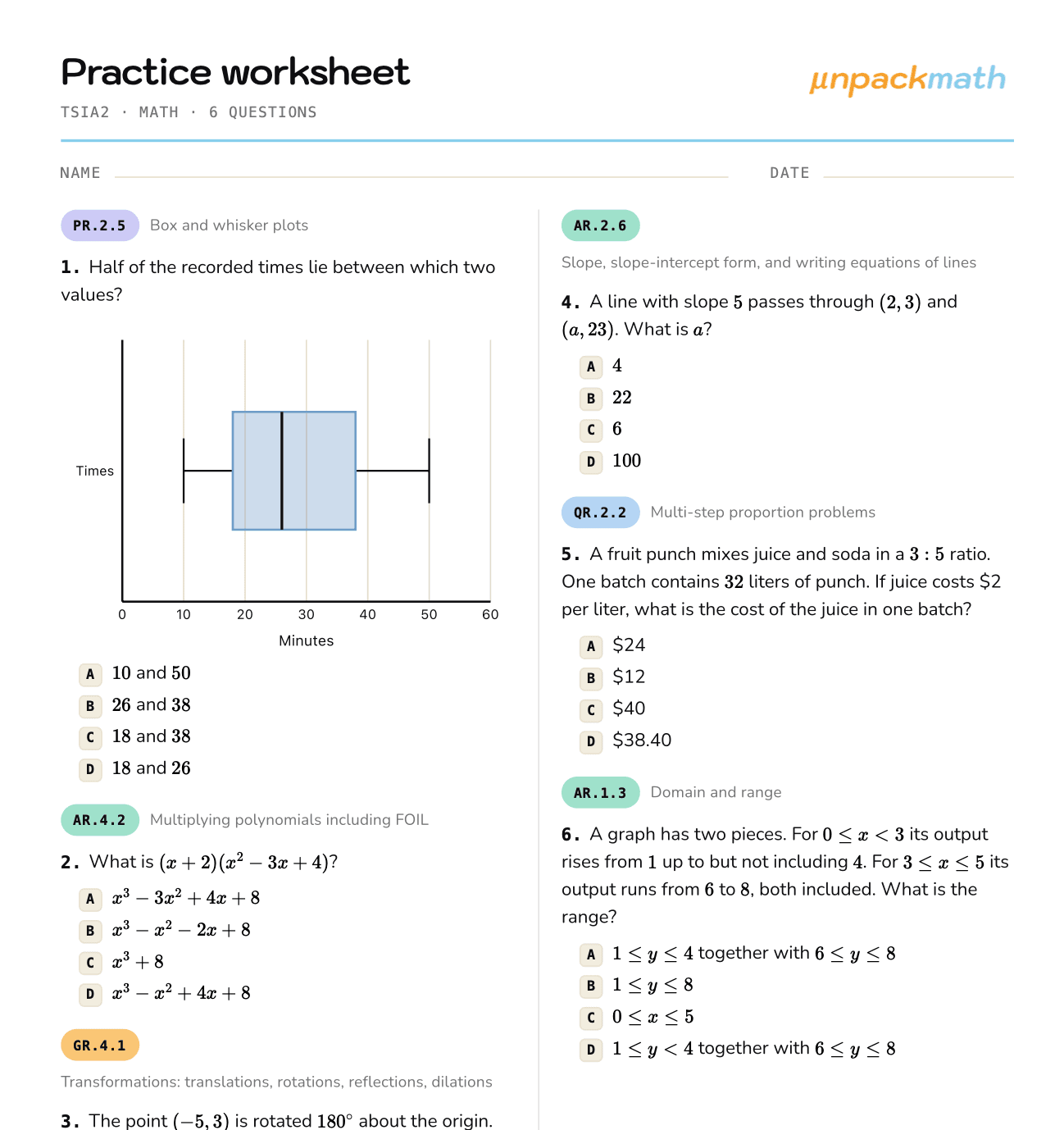
Consistent TSIA2 practice across every classroom.
Give every teacher on campus unlimited, strand-aligned worksheets with full answer keys. Same quality in every room, printed in seconds, no hunting for reliable materials.
Talk to usWhat a fall pilot looks like
The first question is always the same one: what would this actually look like on our campus. Here is how I think a pilot should be structured.
- SCOPE
Named TSIA2 sections, not the whole campus. We agree up front which classes are in, and those are the only rosters that get loaded.
- PERIOD
A defined evaluation period, agreed up front, so a department can evaluate the tool without starting a procurement cycle to do it.
- REVIEW
A meeting at the end of it. We sit down with the data and the department decides whether it continues.
- Movement in diagnostic scores from first attempt to last
- TSIA2 passage rate for the students in the pilot sections
- Whether teachers actually opened the dashboard, and how often
That third one is on the list on purpose. A tool nobody logs into did not work, no matter what the score data says.
Tell us what you are working with
In conversation with Texas high schools and community colleges. If you are planning for your TSIA2 cohort, we would like to hear what you are working with.